
Zoho Zia Chat: A New AI Interface for the Modern Enterprise
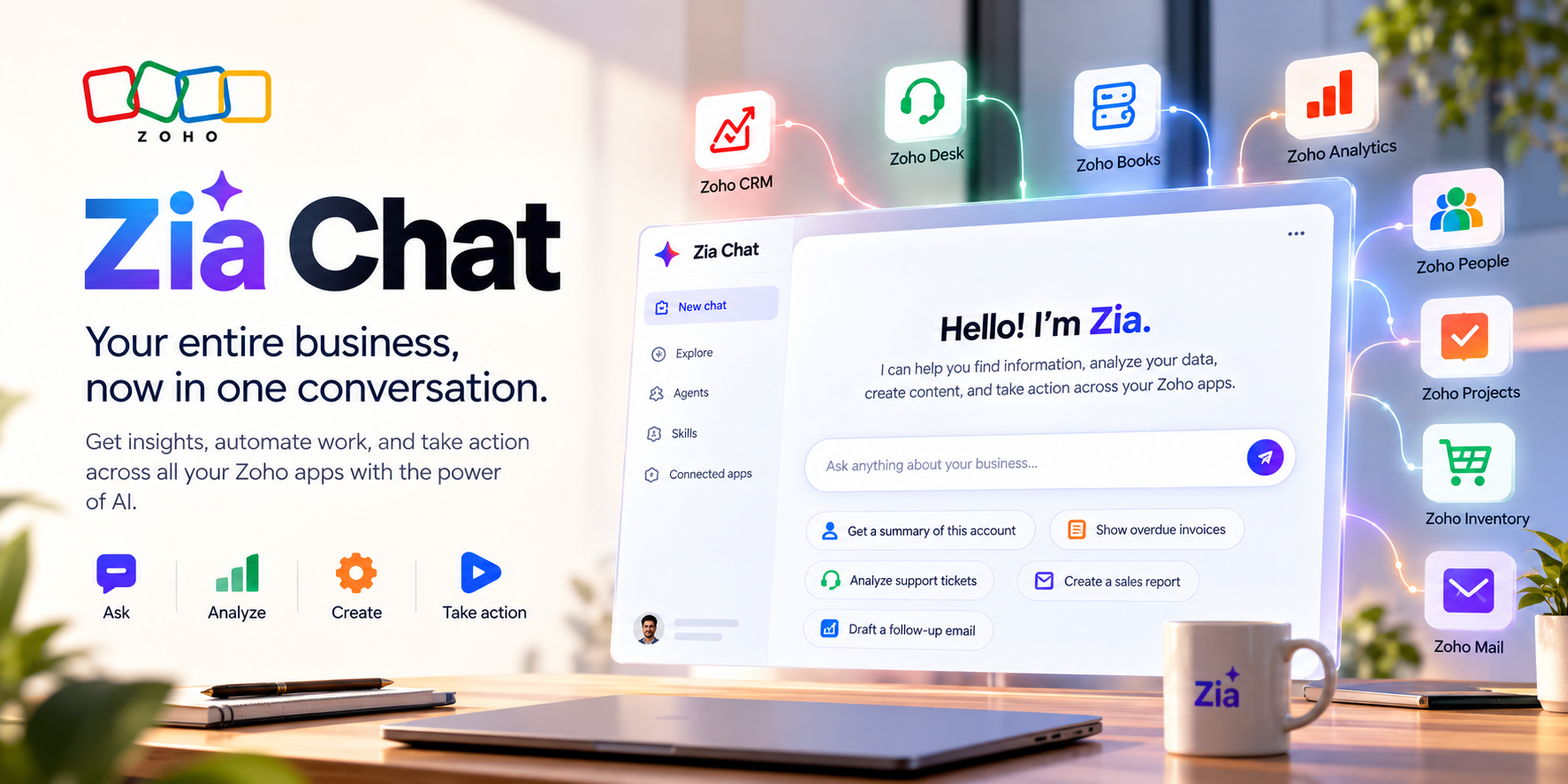
Zoho has introduced Zia Chat, a new AI interface designed to bring business information, applications, and workflows into a single conversational experience.
Announced on September 23, 2026, Zia Chat extends Zoho's AI strategy beyond individual application assistants. Rather than interacting separately with CRM, Desk, Books, Analytics, or other business applications, users can access relevant information across the Zoho ecosystem through a unified interface. Zoho says Zia Chat can connect with more than 45 Zoho applications and can also interact with external systems through Model Context Protocol (MCP).
A unified interface for business data
Most organizations operate across multiple applications. Customer information may reside in CRM, support history in Desk, financial records in Books, and performance data in Analytics.
Traditionally, obtaining a complete view requires employees to search each application individually and manually connect the information.
Zia Chat introduces a different approach.
A user can ask a business question in natural language, and Zia Chat can retrieve and contextualize information from the systems that are relevant to that request.
For example, instead of reviewing a customer's deals, support tickets, and invoices separately, a user could ask for a consolidated account summary and use the resulting information to understand the customer's current position.
The value is not simply faster search. It is the ability to connect information that already exists across business applications.
From conversational AI to business execution
Zia Chat is designed to go beyond generating responses.
Zoho's broader Zia architecture combines conversational capabilities with Zia Agents and Zia Skills, allowing AI-driven workflows to interact with business systems and perform configured actions. These can include updating records, assigning tasks, escalating tickets, sending communications, and executing multi-step processes.
This creates a more complete workflow:
Understand → Analyze → Generate → Execute
For example, a sales team could use Zia Chat to identify accounts with upcoming renewals, review recent support activity, examine payment status, and prepare a follow-up action without manually navigating several applications.
The underlying applications remain important, but the conversational interface reduces the need for users to understand exactly where every piece of information is stored.
Context is the differentiator
One of the more significant aspects of Zia Chat is its focus on relationships between business entities.
Zoho describes technologies including semantic search, resolvers, the Work Graph, and proximity signals as part of the infrastructure that helps Zia identify relevant entities and relationships across its applications.
This is important because business information is inherently connected.
A single customer can be associated with:
- Contacts
- Deals
- Support tickets
- Invoices
- Projects
- Emails
- Campaigns
- Tasks
A conventional search experience may return individual records. A context-aware AI system can use those relationships to construct a broader picture of the customer's activity.
That distinction is central to Zoho's approach.
Extending beyond the Zoho ecosystem
Zia Chat is not limited to native Zoho applications.
Zoho is incorporating Model Context Protocol (MCP) to enable connections with external services and tools. Applications that expose compatible tools through MCP can potentially become part of the same AI-driven workflow.
For organizations with hybrid technology environments, this is particularly relevant.
A company may use Zoho for CRM and finance while maintaining separate platforms for logistics, internal databases, payments, analytics, or specialized operational systems. MCP provides a standardized mechanism through which those external capabilities can participate in a conversational workflow.
For developers and Zoho partners, this also expands the scope of what can be built around Zia.
Security and permissions
Enterprise AI requires more than useful answers. It must also respect existing access controls.
Zoho states that Zia Chat operates within the user's existing application permissions. Information that the user is not authorized to access should not become available simply because it is requested through an AI interface. Zoho also says business data accessed through Zia Chat is not used to train its AI models.
Actions that modify business data can also be subject to authorization and approval controls.
This is particularly important as AI moves from generating information to taking action inside production systems.
Model flexibility
Another notable aspect of Zia Chat is Zoho's model-agnostic approach.
Rather than building the product around a single external AI model provider, Zoho says organizations can use supported models according to their requirements. During the current early-access phase, Zoho supports OpenAI models through Bring Your Own Key (BYOK), with plans to support additional models, including Anthropic and Zoho-hosted Zia models in selected regions.
For enterprises, model flexibility can matter for several reasons, including governance, cost management, privacy requirements, and model selection.
Practical business applications
The potential use cases extend across departments.
Sales
Sales teams can combine CRM activity, support history, payment information, and account activity to build a more complete customer view.
Customer support
Support teams can correlate tickets with customer records, projects, previous interactions, and commercial information before responding.
Finance
Finance teams can investigate outstanding payments, review associated accounts and transactions, and initiate follow-up processes.
Operations
Operational teams can combine information from inventory, orders, projects, and other systems to identify issues and coordinate actions.
Management
Executives can use conversational queries to bring together information from multiple departments and generate reports, summaries, or presentations.
The common theme is cross-application context.
Early access and availability
Zia Chat is currently available through early access, which Zoho says is free during this phase. Final pricing and licensing details have not yet been announced.
Zoho currently lists availability in its India and US data centers, with additional regions planned. The product currently supports English for its interface and user interactions.
What Zia Chat represents for Zoho
The significance of Zia Chat goes beyond the introduction of another AI assistant.
Traditional enterprise software is organized around applications:
CRM for customer relationships
Desk for support
Books for finance
Analytics for reporting
Projects for collaboration
Users have traditionally been responsible for moving between these systems and connecting the information themselves.
Zia Chat introduces a different interaction model:
Business context → Natural-language request → AI reasoning → Business action
The applications do not disappear. Instead, the AI layer becomes a new way of interacting with them.
That shift could make business software less dependent on application-specific navigation and more focused on outcomes.
The bigger direction of Zia
Zia Chat is part of Zoho's broader investment in enterprise AI, which includes conversational interfaces, AI agents, skills, application intelligence, and integrations.
The company's direction is increasingly centered on building an AI layer that understands not only individual records, but also the relationships, workflows, permissions, and operational context surrounding them.
For Zoho customers, that could mean fewer fragmented interactions across applications.
For developers and partners, it creates another layer for building intelligent workflows, integrations, and business automation.
Conclusion
Zia Chat represents a significant step in Zoho's evolution toward conversational enterprise software.
Its core proposition is straightforward: bring business information and capabilities together so users can interact with their systems through natural language rather than navigating each application independently.
The product is still in early access, so pricing, regional availability, and additional capabilities will continue to evolve. However, the underlying direction is already clear.
Zoho is positioning Zia not merely as an assistant that answers questions, but as an AI layer capable of understanding business context and connecting that context to real work.